
How breeze connects PIM, ERP and e-commerce – without the hassle
Integrations should, in theory, make systems work together seamlessly.
In practice, many experience the opposite: manual processes, error messages that appear at the wrong time, duplicate data, and a constant dependence on "that one person" who knows how everything fits together.
The result is unnecessary friction, higher risk and less control in everyday life.
This is exactly where the breeze integration platform comes in and cleans things up. By bringing together PIM, ERP and e-commerce into one structured and controlled data flow, breeze ensures that information is always synchronized and up-to-date – without you having to spend your time putting out fires.
When the systems each speak their own language
In many businesses, the division of roles is clear: Product data is handled in the feed PIM, pricing, inventory and logistics live in the ERP, and customers encounter the products in the online store. The challenge arises when these systems are connected via fragile point-to-point integrations, heavy customization or manual routines that are only discovered when something goes wrong.
The consequences then quickly become noticeable. Processes run slower, the risk of errors increases, and the overview disappears.
It is far from an efficient and future-oriented setup.
breeze as the hub of the data flow
Breeze provides an intelligent middleware that acts as the hub of your integration architecture. Instead of systems talking directly to each other, they talk to Breeze. The platform provides structure, validation, and control – establishing a single, shared truth across systems.
This provides a better overview, fewer errors and a much more stable data flow.
Flexible product creation – on your terms
Every business works with product data a little differently. Some want to create products directly in the feed PIM, where content, structure and enrichment are the focus.
Others prefer to start in ERP, where item numbers, logistics and finance are leading.
With breeze, you don't have to choose one right way – the platform supports both.
The point is simple: You work where it makes the most sense for your business, while breeze ensures that the rest of the system landscape fits in seamlessly.
When the product is created in feed PIM
For many, feed PIM is the natural starting point for new products. Here, the product is built from the ground up, with the right descriptions, categories, images and attributes. Once the product is ready, breeze takes over.
The platform ensures that product data is validated and mapped correctly before it is sent on to the ERP and the online store(s).
This ensures that only quality-assured information flows forward, and that all systems receive data in the correct format.
The result is a structured and controlled product flow, where feed PIM acts as a master for content, while ERP and e-commerce receive updated and consistent data – without any manual intermediate steps.
When the product is created in ERP
In other cases, the product journey starts in ERP. This may be because item numbers, inventory management or financial processes need to be in place first. Here too, breeze adapts to your workflow.
When a new product is created in ERP, breeze automatically captures this and ensures that the necessary information is sent to feed PIM. There, the product can be enriched with content, structure and market data before being published to the online store.
This approach provides full control over business-critical data in ERP, while still using the feed where it provides the most value – to make products marketable and visible to customers.
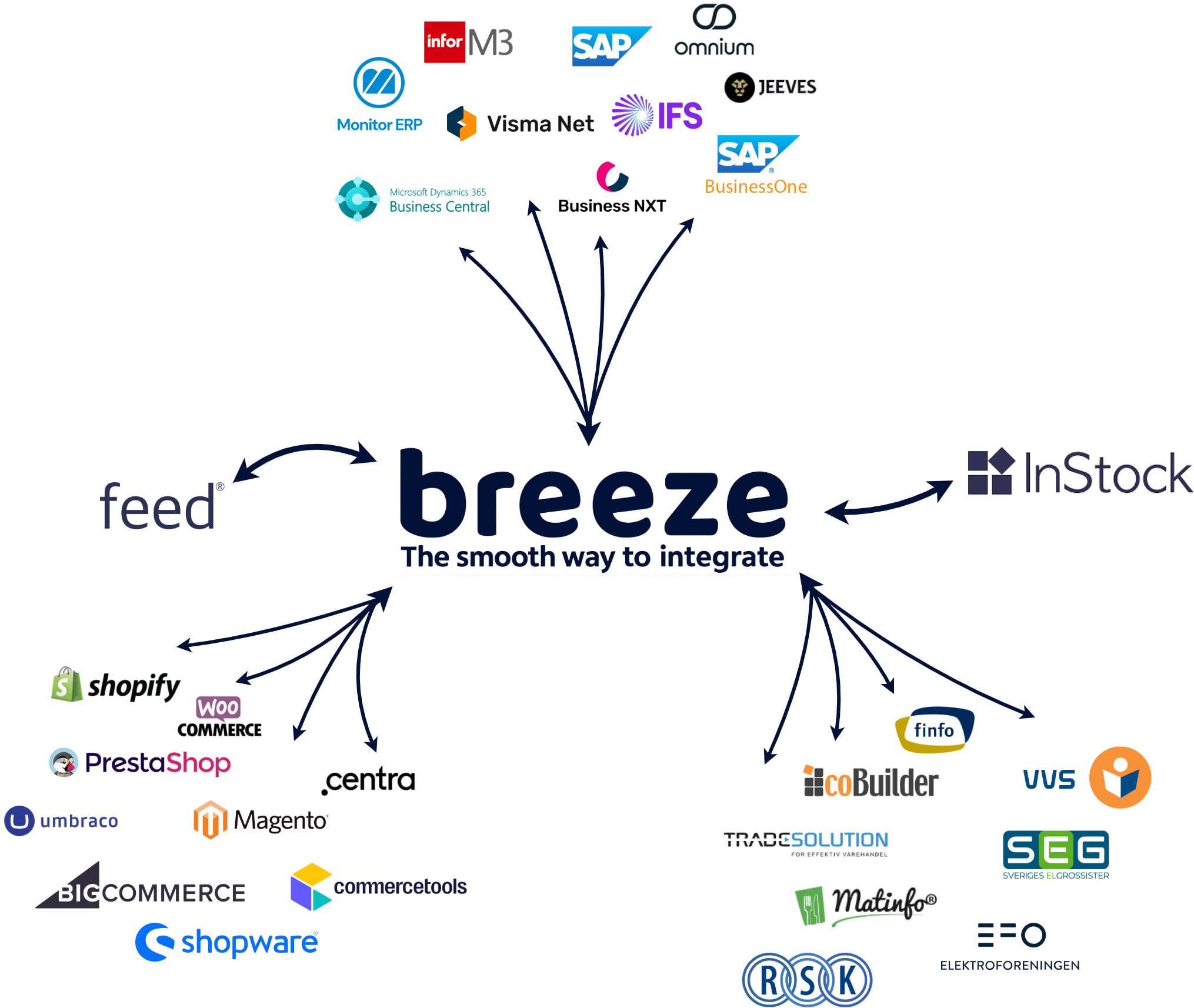
One continuous process – regardless of the starting point
Regardless of whether the product is created in feed PIM or ERP, the end result is the same: A holistic, traceable and stable product flow. breeze ensures that the systems speak the same language, that changes are handled in a controlled manner, and that everyone can trust that the data is correct.
You avoid duplication, manual corrections and uncertainty about where the "answer" actually lies. Instead, you get flexibility in your everyday life – and a solution that scales with your business.
A simpler everyday life – also in the long term
By consolidating your integrations in breeze, you reduce the complexity of your IT landscape. Integrations can be reused, the architecture is scalable, and all data flows are traceable. Perhaps most importantly, you become less dependent on custom solutions that no one dares to change.
When PIM, ERP and e-commerce actually work together, something positive happens throughout the organization. You get faster time-to-market, better data quality, happier customers and less stress internally.
breeze is designed for just this – to make complex integrations simple, robust, and future-proof.
Or put in a simpler way:
The systems do their job. You don't have to worry.