
We've waited long enough. Now feed PIM gets the API it deserves!
Since 2019, a single API has carried millions of product updates. It has done the job. But the world has moved on, and now so have we.
When feed 2.0 was launched in 2019, it came with an API. Not because it was a big deal at the time, but because integrations were necessary. Customers needed to get data in and out, and we solved that. Since then, we have been steadily expanding it, feature by feature, as the solution has grown. That API has done a formidable job.
Many millions of products have been created, updated, and distributed through it. We are proud of that. But we are honest enough to admit that it bears the hallmarks of having grown organically over six years. It is time to build something new, from the ground up, with what we know today.

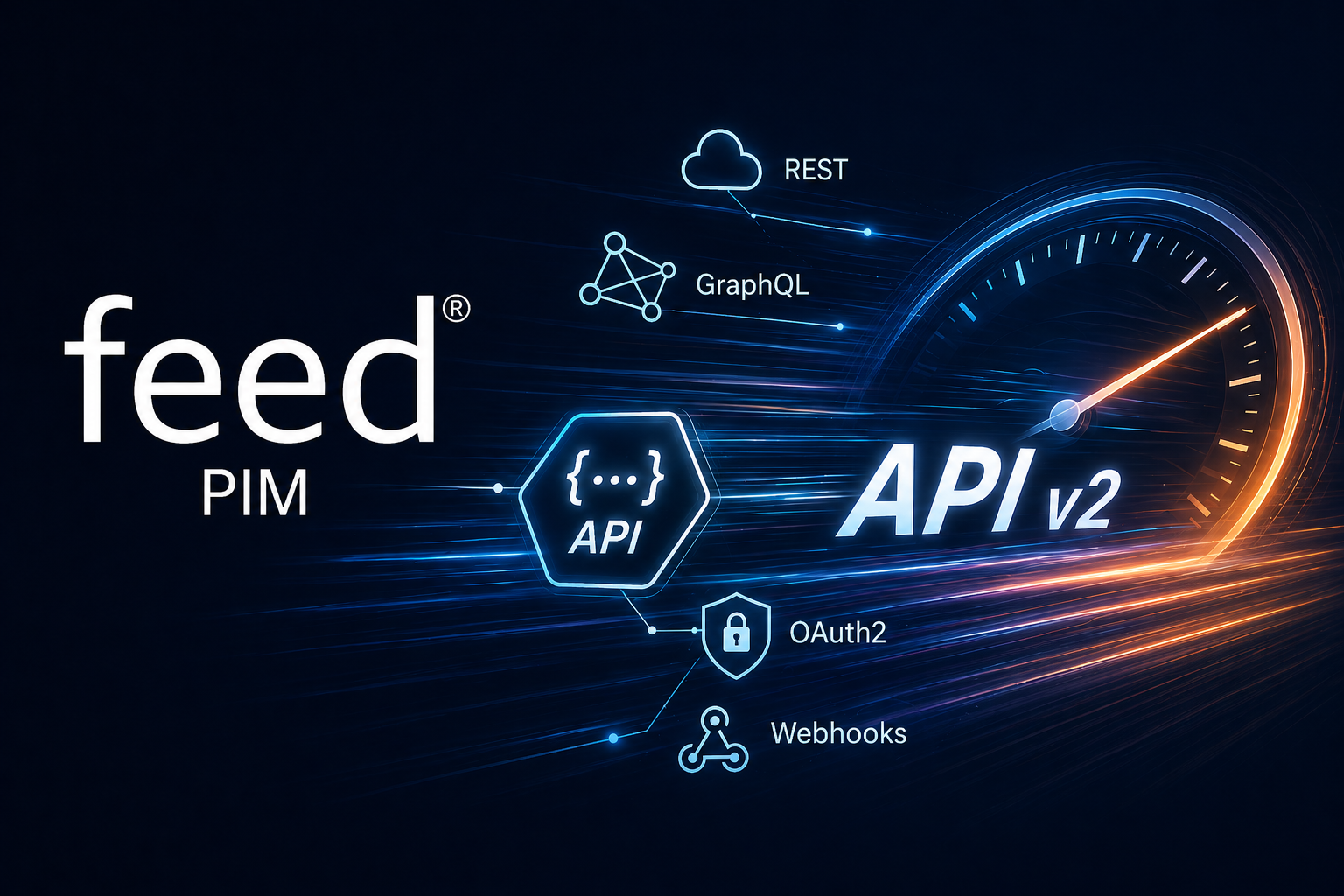
After six years of continuous growth, feed is now taking a big step forward. API v2 is built from the ground up to meet today's needs - with a single unified interface, support for both REST and GraphQL, and modern security with OAuth2.
The result is faster integrations, more flexible data authentication, and a solid foundation for future development. With webhooks on the way, feed becomes even more proactive – and an even stronger engine in customers’ digital ecosystem.
Erik Saly, head of feed PIM
The right tool for the right job
The old API was split into two: /import to write data and /export to retrieve it. In v2, everything is gathered under /api. One address, one consistent interface.
REST handles the simple and direct calls: create, read, modify, and delete across products, attributes, media, structures, and master data. It's predictable and fast to deploy. GraphQL is for the more demanding use cases: retrieve exactly the fields you need, filter on what you want, and get rid of the data you don't need. An interactive explorer at /api/graphiql lets you test and explore directly in your browser.
API v2 in brief
REST for simple and direct calls: products, attributes, media, structures and basic data
GraphQL for advanced product retrieval with flexible filters and field selection
OAuth2 with JWT, with separate access levels for reading and writing
Multilingual from scratch, with sorting by language code
Swagger / OpenAPI at /api/swagger-ui, always up to date
RFC 7807 error format: machine-readable and predictable error messages
Webhooks: data coming to you
Shortly after the launch of API v2, webhooks are coming. This means you no longer have to ask feed if something has changed. feed tells you itself, the moment it happens. It's a fundamental change in how integrations can work, and something we know many have been waiting for.
An investment in what is to come
API v2 is not just a technical upgrade. It is a recognition that feeds play an increasingly important role in customers' digital infrastructure. A PIM system is no longer a place where you log in and make changes manually. It is the hub of a data flow that extends to online stores, marketplaces, partners and internal systems. An API that grew gradually without an overall plan is not enough.
With REST, GraphQL, and webhooks in place, we have the foundation we need to build on in a way that was difficult with the old API. It also allows us to move forward more quickly, with new resources and capabilities as the feed evolves.
We are in the final stages now. Testing and refinements are underway. Launch is approaching and we are excited! Do you have any questions or want to stay up to date on what's coming? Get in touch, we'd love to hear from you.