
Is your product data ready for Agentic Commerce?
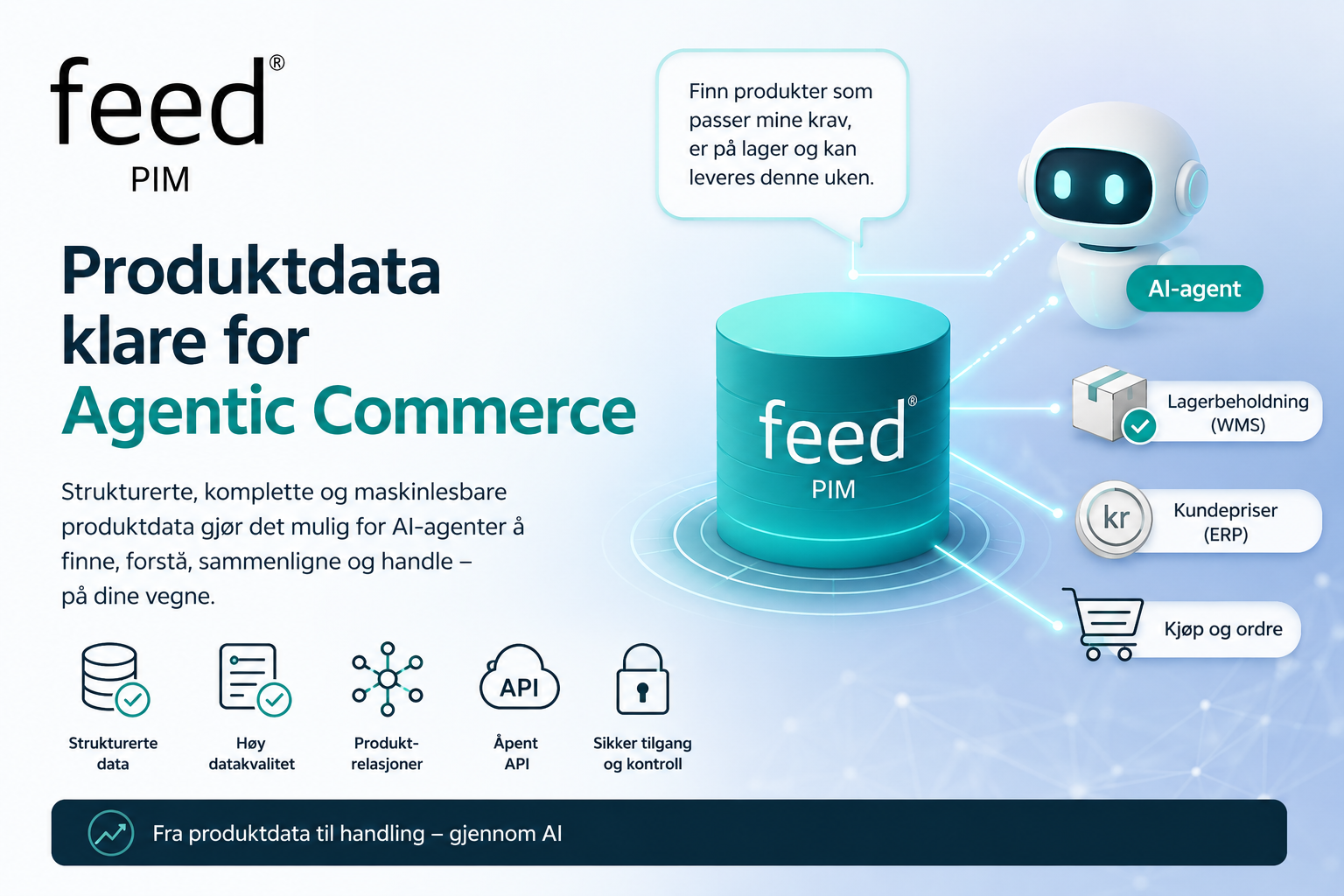
From online store to AI agent
In traditional online shopping, the customer visits an online store, searches for a product, uses filters, compares options, and completes the purchase.
With Agentic Commerce, parts of this process can be moved to an AI agent.
The customer can instead describe the need:
“I need a circulation pump that can replace this model, withstands these operating conditions, and can be delivered this week.”
The agent must then be able to find relevant products, understand technical characteristics, compare alternatives and decide which products actually meet the requirements.
It's not enough for the product information to just look good on a product page.
The product data must be understandable by machines.
PIM gets a new role
PIM has traditionally been the system that collects, structures and enriches product information before it is distributed to online stores, catalogs, marketplaces and other channels.
With Agentic Commerce comes a new recipient:
The AI agent.
This means that PIM should not only deliver product information to people and traditional digital channels. Product data must also be made available in a structured way so that AI systems can search, interpret and use the information.
This makes PIM an important part of the infrastructure for Agentic Commerce.
Six questions you should ask about your product data
1. Is the product information structured?
If important product features are only found in free text, PDFs, or product descriptions, it becomes more difficult for an agent to accurately compare products.
Size, material, capacity, power, compatibility, certifications and other properties should, as far as possible, be found as structured attributes.
2. Is the product data complete?
An AI agent can only work with the information it is given access to.
Lack of technical data, documentation, images, relationships or classifications can therefore make a product less relevant – even if the product is actually the best option.
Data quality thus also becomes a question of digital visibility.
3. Do the systems understand the relationships between the products?
What are accessories? What replaces a discontinued product? Which products fit together? Are there alternative products?
Such product relationships can become very important when an AI agent needs to solve a need instead of just finding an item number.
4. Can the product data be retrieved automatically?
AI agents cannot be relied on to read web pages in the same way as humans.
Product information should be made available through modern interfaces and structured data sources.
In feed PIM, product data can be made available through APIs, and we are continuing to work on how external AI agents can gain controlled access to relevant product data.
5. Can product data be combined with information from other systems?
Product data alone is not always enough.
A customer may ask:
"Which of these models fits my needs and is in stock?"
Then product information must be able to be combined with, for example, inventory from WMS and customer-specific prices from ERP.
Agentic Commerce is therefore not just about AI. It is also about integration between the systems that contain the information the agent needs.
6. Do you have control over what data an AI agent can use?
The fact that data can be made available does not mean that all data should be open.
The company must be able to control what product data, inventory data, prices, and other information different users and agents have access to.
Security, authentication and access control therefore become a central part of the infrastructure around Agentic Commerce.
From SEO to AEO – and on to action
Businesses have been working with SEO for many years to be found in Google.
Now it is also becoming important to make information understandable for AI services and AI agents.
But Agentic Commerce takes this one step further.
It is no longer enough for AI to be able to find the product.
It must be able to:
understand → compare → recommend → check availability → and finally help complete the purchase.
This places completely different demands on product data.
Where does feed PIM come in?
feed PIM collects and structures product information from, among other things, ERP systems, suppliers and industry databases.
Data can be enriched with attributes, texts, media, classifications, relationships and languages before the information is distributed further.
The same structured data base can also become the foundation for AI agents.
Our direction is therefore clear:
Product data should not only be ready for the online store and Google. It should be ready for AI agents.
Agentic Commerce doesn't start with AI
It's easy to start the discussion about Agentic Commerce with language models, AI agents, and new technology.
We think it's better to start somewhere else:
With the data.
If the business has control over the product information, structure, data quality, relationships and integrations, it has already built a large part of the foundation that Agentic Commerce needs.
If not, it's a good place to start.
Contact us for a no-obligation chat and demo of feed PIM
Read more about feed PIM here