
What is Agentic Commerce – and why should you care?
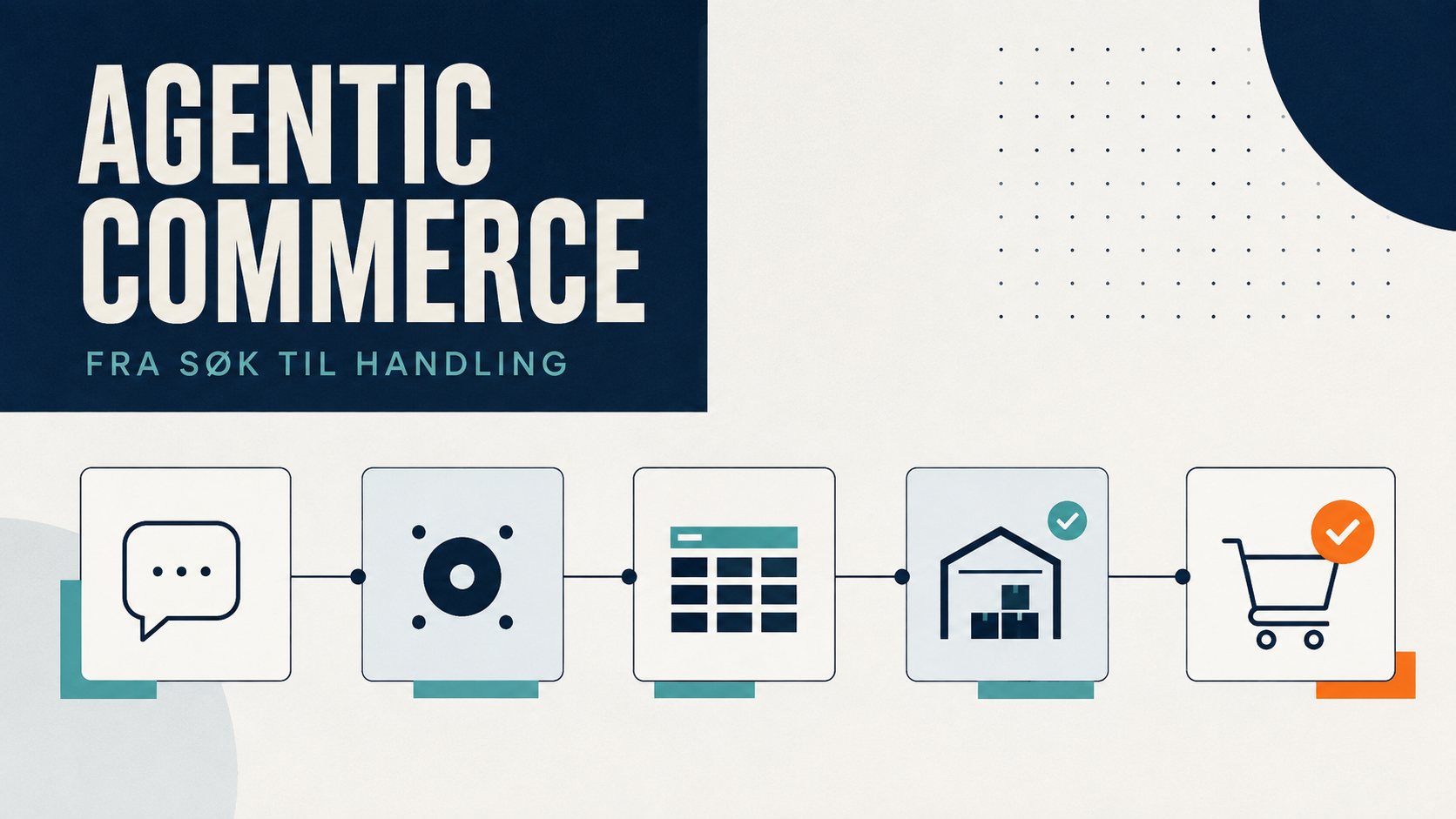
We've become accustomed to using artificial intelligence to find information, write texts, and compare options. Now comes the next step: AI agents that not only provide advice, but can also perform tasks on our behalf.
This is called Agentic Commerce – and it could change how products are found, reviewed and purchased.
From search to action
In traditional online shopping, the customer often starts with a Google search, visits several online stores, compares products and makes the purchase themselves.
With Agentic Commerce, the customer can instead give an AI agent a task:
"Find an energy-efficient water heater that fits a family of five, can be delivered this week and costs under 20,000 kroner."
The AI agent can then:
find relevant products
compare features, documentation and prices
check stock status and delivery time
recommend the best option
and then complete the order
The customer's dialogue is thus moved from the online store to the AI agent. This does not necessarily mean that the online store will disappear, but it is no longer the only product channel.
The AI agent needs more than a good product text
An AI agent does not evaluate products in the same way as a human. It needs structured, up-to-date, and machine-readable data to understand what a product is, who it is suitable for, what features it has, and whether it can actually be delivered.
A nice product image and good marketing copy are still important. But it's not enough if the information the AI agent needs is scattered across PDFs, spreadsheets, ERP systems, and various online stores.
To be selected, the product must have, among other things:
clear and correct product names
structured technical features
good categories and product relationships
information on applications and compatibility
photos, documentation and certificates
updated stock status and delivery time
data that can be shared through modern interfaces
In Agentic Commerce, good product information is not just a competitive advantage. It becomes a prerequisite for visibility.
What does this mean for manufacturers, wholesalers and retailers?
Previously, visibility was largely about ranking high on Google and getting customers into your online store. Going forward, businesses will also need to make their products understandable and accessible to AI agents.
The best website doesn't necessarily win if a competitor's products have more complete, accurate, and accessible data.
Businesses should therefore start asking some new questions:
Can an AI agent understand what our products are used for?
Is the product information structured and consistent?
Does the agent know which products and accessories go together?
Can it check if the item is in stock?
Is the data accessible through APIs and other machine-readable interfaces?
Can an order be forwarded to the ERP or e-commerce system in a controlled manner?
Product data, inventory and integrations must work together
Agentic Commerce is not about a single AI solution. It requires multiple parts of a business's digital infrastructure to work together.
feed PIM collects, structures and enriches product information. InStock WMS provides access to up-to-date stock status and availability. breeze ensures that information and orders can flow between PIM, WMS, ERP, e-commerce and other systems.
When these parts are connected, the AI agent can access both product data and the operational information needed to execute a real trade.
Do we have to do everything now?
No. Agentic Commerce is still evolving, and technology, standards, and purchasing habits will change. But the foundation should be built now.
The work of collecting, structuring and quality-assuring product data has value already today. It results in better online stores, more efficient integrations, easier publishing, better search and less manual work. At the same time, it prepares the business for new sales channels and AI agents.
The most important first step is therefore not to buy yet another AI tool. It is to gain control over the data and systems that the AI agents will work with.
Why should you care?
Because future customers won't always visit your website before choosing a product.
Some will hand over large parts of the purchasing process to an AI agent. If the agent can’t find, understand, or trust your product information, the product may be left out before the customer even sees it.
Businesses that start preparations now will have a better starting point when AI agents move from making recommendations to executing real trades.
AI provides speed. People provide direction. Good data makes trading possible.