The market has decided: best of breed has won
There are still players in the Norwegian software market who sell customization as the path to competitive advantage. The argument is familiar: "Your business is unique, therefore the solution must be built specifically for you." It sounds logical. It is also fundamentally outdated.
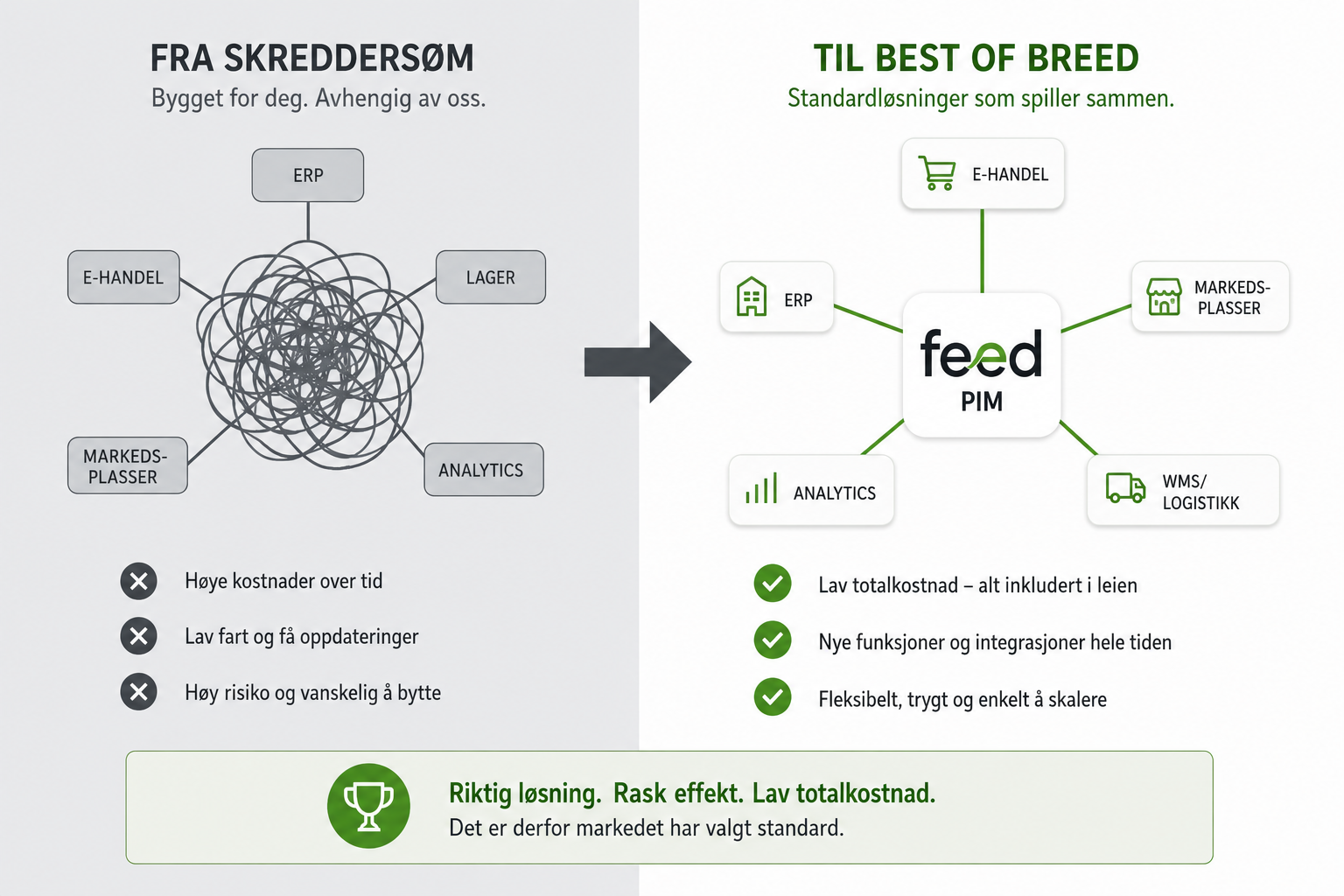
Look at how large, mature businesses actually build their IT stack today. Not as a monolithic, bespoke solution from one agency. Not as one system that covers everything. They choose best of breed — specialized standard solutions for each domain, connected via open APIs.
The math behind tailoring
When a development agency offers a custom solution, the price of development is just the ticket. The real costs come over the years: maintaining a code base that only a few people understand, security updates that are the customer’s job alone to keep up with, upgrades that have to be built from scratch every time an integration point changes, and a gradual realization that the developers who delivered the solution have quit, changed technology stacks, or priced themselves out of the market.
Standard software like feed PIM works fundamentally differently. You pay a monthly rental — and that's it. No development costs on top. No separate invoices when the platform is expanded with new features. No negotiation about who will cover the next upgrade. The rental covers a living platform in continuous development, with new releases every other week. Functionality, performance, security and integration options are continuously improved, and that's included.
What best of breed actually means in practice
The modern enterprise stack is a composition of specialists: a PIM for product data, an ERP for finance and logistics, a WMS for warehouse - like InStock WMS , an OMS for order orchestration, a DAM for digital assets, an e-commerce platform for the front end.
Each of these components is built by teams that do one thing and do it better than an agency of generalists can. A development house that is going to deliver a custom PIM also has to solve the same problems that hundreds of PIM vendors have spent a decade solving — from variant management and translation workflows to channel-specific syndication and AI-powered attribute enrichment. What they tend to deliver is a database with a user interface on top. That’s not the same as a PIM.
Integration is no longer the bottleneck
A common argument from vendors selling customization is that “no standard solution can handle their specific integrations.” That argument was valid in 2010. Today, it’s outdated.
Modern standard software is built API-first. feed PIM exposes the entire data model via REST and GraphQL, has webhooks for event-driven integration, OAuth 2.0 for authentication, and connects to ERP, e-commerce, marketplaces, and channels through documented interfaces. The unique business logic is not in how product data is stored — it is in how the data flows between systems, and it is orchestrated without writing a single line of PIM code.
The paradox is that the more integration-heavy the business, the stronger the argument for standard software. Customization provides one vendor's interpretation of integration standards. Off-the-shelf provides a platform that has already been tested against dozens of ERPs, hundreds of online stores, and thousands of integration scenarios.
Living software — release every other week
A custom solution is static from the day it is delivered. If it is to be developed further, the customer must order and pay for each and every improvement.
feed PIM is continuously developed, with new releases every other week. Enhancements, new functionality, integration extensions, security updates and performance improvements come automatically — as part of the lease. The platform is living, not a one-off delivery project. This means that your business does not stand still while the market moves.
The hidden risk suppliers don't talk about
Customization is often sold as "freedom from vendor lock-in." The reality is the opposite. When the code resides with one agency, a lock-in occurs that no SaaS contract can match. The customer owns the source code on paper, but not the expertise to further develop it. Changing vendors means starting over in practice.
With a standard product used by many customers, an entire ecosystem of certified partners, documentation, user forums, and a vendor contractually committed to roadmaps and uptime. The data is in open, documented formats — the exit strategy actually works.
Fast effect, lowest possible cost
There is another aspect that is often under-communicated: time to value. A custom solution takes months or years to build before it delivers first value. Off-the-shelf software delivers from day one — functionality that has already been built, tested, and refined by an entire community of users. Implementation is about configuration and integration, not basic development.
This is the equation the market has realized: choose the standard solutions that best suit each domain, create impact quickly, and keep the total cost low — because the rent covers everything and the platform is developed further at no additional cost.
What the CTO should ask the vendor
When a supplier proposes customization, there are three questions that determine the conversation:
What is the realistic total cost over five years, including maintenance, security, upgrades, and integration changes? Compare that to a SaaS license on a mature, standard product, where everything is included in the rent.
How often are new versions released with new functionality — and how much does it cost? With feed PIM , the answer is every other week, and it costs nothing extra.
What is the exit cost if the supplier stops delivering? With feed PIM , all data can be exported in open formats and the platform can be changed. With a custom solution, the exit cost can be to build everything from scratch.
The conclusion
Customization has its place — in the narrow cases where the business has a truly unique need that no platform covers, and where development constitutes a real competitive advantage. For everything else, and especially for basic infrastructure such as product information management, warehousing and logistics, the market has already provided the answer: choose a standard, integrate openly, and use the saved resources on what actually differentiates the business from the competition.
feed PIM is built for this very role — the standard component of a modern best-of-breed stack. Modern, API-driven, scalable, living — with new releases every other week, all included in the rent.